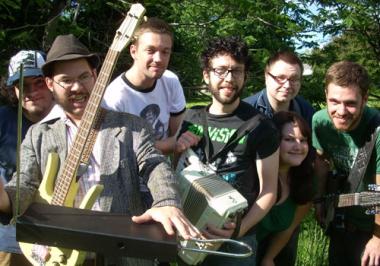
Los Hijos Unicos is a band on a mission: to make country music cool again. This might seem like an ambitious undertaking to some, but the eight-person outfit—with members from Northampton, Somerville and the North Shore—is a confident lot. Plus, it is armed with its own subgenre, one its members have dubbed "Alien Country."
"We've always called it Alien Country because we were committed to bringing alien sounds to our music; we wanted to use instruments and production techniques of the Beatles and the Beach Boys in country songs," explains vocalist, bassist and banjo player Ryan Quinn. "To that end, we might use a theremin, or sing four-part harmonies live, or do something like create tape loop song endings."
"Alien Country has a second meaning, though, because the music is also alienated from the sound people refer to when they use the word 'country,'" Quinn says. "We're coming to realize that we don't fit in with the roots scene we were playing with in Boston, and that we have a lot more in common with a band like [Valley power-pop band] The Novels than with most country and roots bands."
The group met at the Massachusetts College of Liberal Arts in North Adams. It came together in 2006 when Quinn's punk band, Karate Kid Death Squad, disintegrated. "I had been writing songs that were too country for the other members, and they were playing them too punk for me," says Quinn. So he and fellow KKDS band member and multi-instrumentalist Isaac Sussman started Los Hijos Unicos and invited a bunch of friends to join in.
Quinn headed to Western Massachusetts last year to get a master's degree in Labor Studies at UMass-Amherst, and is trying to recruit the rest of the crew to move to the area. And the band name?
Quinn says, "The name comes from a poem scrawled on a Red Line subway car seat that stuck in my head, and a dream where my spirit animal told me that the band must be named after the poem."
Alien, indeed.
Los Hijos Unicos claims to be influenced by sounds from Hank Williams to Stax soul to The White Stripes. Quinn says he writes most of the songs on acoustic guitar and then gives them to the rest of the band with basic directions on how to flesh them out: "The group arranges the songs, and together we develop vocal harmonies and sometimes each others' parts." The band has one album, 2006's ∧ the lights go out, and is currently recording its second.
The live stage show is a giant hoedown, with nine people singing and shouting along to twangy tunes about highways, Nebraska and Walter Reed. The instrumentation is varied—including, but not limited to, organ, fiddle, cowbell, glockenspiel and dulcimer—but the star of the show is undoubtedly band member Andy Goulet's theremin.
When he tried out the seldom-used instrument during a tongue-in-cheek rendition of the Beach Boys' "Be True To Your School" during this past winter's Happy Valley Showdown battle of the bands, Quinn says, the crowd's response was overwhelming. "People went wild for the theremin, and we liked the sound," he recalls, "so we've kept it since then. It fills the space where steel guitar should be."
Then there is drummer Chase Billingham. While his bandmates look like they have just stepped out of an Arcade Fire concert, Billingham appears as if he might be auditioning for a role in a Rascal Flatts video. Tall and lanky, he wears a cowboy hat with an oversized American flag button affixed to the front, and a Texas Lone Star flag button-down shirt tucked into his dungarees. He is a sight to behold as he earnestly shuffles along on drums and contributes high harmony vocal parts.
When asked about his drummer's natty attire, Quinn says that Billingham's girlfriend is from Texas, and adds, "If we could afford it, we would all wear matching rhinestone nudie suits like Buck Owens and the Buckaroos."
All this leads to the ultimate question: Is there, in fact, hope for the future of popular country music?
"The music will get better when people start looking back to the sounds of the past rather than cashing in on whatever over-compressed, auto-tuned trend sells today," says Quinn. "It's only a matter of time before we get a new neo-traditionalist wave in mainstream country, trying to bring back the sounds of Johnny Horton or Buck Owens, or even Gram Parsons."
To Quinn, the politics of country music are perhaps even more troubling.
"In most people's minds, contemporary country is solidly aligned with the worst kind of jingoism and xenophobia," he says. "It's my hope that this, too, is cyclical and will pass. Los Hijos Unicos are trying to do our part to bring about the socialist future—both for country music and for the United States."
Most bands just shoot for beer tickets and gas money.