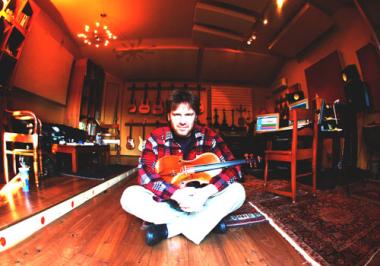
It wasn't until he was in junior high school that Craig Eastman spent two consecutive years in the same school. Born in the Pioneer Valley, Eastman moved around the country a lot as a kid; his dad was in the Air Force. Eastman and his family eventually settled back in the Valley and he went on to attend Hampshire Regional high school, then Hampshire College. An accomplished fiddler at an early age—he won the New England Fiddle Championship at age 13—Eastman moved to Los Angeles 13 years ago and began writing and recording film scores. A longtime member of the Hans Zimmer Orchestra, Eastman worked on blockbuster films, including Brokeback Mountain, Pirates of the Caribbean, Pearl Harbor, Black Hawk Down, Miami Vice and The Lost Samurai.
Almost every year around St. Patrick's Day, Eastman and five other musicians convene in the Pioneer Valley to play a handful of shows as Bo Fitzgerald and the YankCelt Band. All venerated musicians in their own right, the other members of the YankCelt Band are frontman Robert Emmet "Bo" Fitzgerald, accordionist Michael "Mixie" Clarke (who crosses the pond every year from Ireland), guitarist Jeff Sullivan, bassist Guy DeVito and drummer Billy Clock.
Recently back from Bali, where he was working on music for Green Flash, a film about pro beach volleyball, Eastman chatted with the Valley Advocate about his love for music, what it's like working on blockbuster movies and why he perennially returns to play with the YankCelt Band.
Valley Advocate: What was your first experience with music that made you realize you wanted to spend your life making it?
Eastman: I was five years old, living in Tucson, Arizona. I was going to a nursery school called Boots and Saddle. They had violin lessons there. I think that's when I got hooked… I started taking lessons a year later, thinking it was just the coolest thing. Then I studied classical music for about six years, until I got really frustrated with it and quit. Shortly thereafter, I happened to go to a fiddle contest in Cummington, Mass. I just fell in love with it. I was 11. It was everything I was missing from my experience with classical music: people were playing really fast, energetic music and the audience loved it. Then, when I was 13, I won the New England fiddle championship. It was in Bushnell Park in Hartford in front of 50,000 people. They had all kinds of different categories, and the one that I won was open to all ages. It was the "trick and fancy" division—you can play anything you want. It was just great. They judged it partially on audience applause. You've got 50,000 people just screaming for you.
What instrument is your favorite to play?
Well, my very first instrument was the recorder, thanks to the Amherst school system…
Fiddle is definitely my favorite thing to play, but I play pretty much any stringed instrument, in just about every musical style. Since I got to Los Angeles, I've been doing a lot of film music. With that, you can play anything from all over the world, like Middle Eastern music, Asian, Deep South Delta blues … I've used this as an excuse to keep learning and collecting instruments.
I just got back from Bali, where I bought a bunch of bamboo flutes, a gamelan, which is the equivalent of a xylophone with metal keys you hit with a little hammer, and 150-year-old Arab rebabs [a stringed instrument with Middle Eastern origins]. Over the years I have [amassed] a really amazing collection.
How long were you a part of the Hans Zimmer Orchestra?
I did that for about six years. It was just an amazing experience. [Zimmer] is one of the real icons of film music. I had an amazing experience working on these huge movies. I played and wrote on these big blockbuster movies and got to really learn film scoring from him. He's very generous with teaching the people he's working with how he [writes and records film music]. Just being there looking over his shoulder is priceless. It's a very technology-based way of creating music, because it's all done on computers. On Black Hawk Down, we were using 23 computers that were linked together.
I built my own studio at my home, and for the past several years I have been composing music myself. I still do things here and there for [Zimmer], but more and more, people will just send me computer files and I'll open them up and record my parts and send it back to them. Right now I'm using six computers. It's a really wonderful way to work creatively. It allows you freedom. Besides working in the traditional way of playing and scoring music, you can treat it like a collage and take bits of pieces of music and move them around or stretch them out.
What is your favorite movie that you've worked on the soundtrack for?
Well, I love the first Pirates of the Caribbean movie. I thought that was just really fun. But, musically, I think Black Hawk Down. For that movie, we had a $12 million budget to spend in about a month. We were flying huge koto drums over from Japan; flying great singers in from Africa. That was just a really fun movie—working with Ridley Scott was great. He's one of my favorite directors. He's a genius.
When you're recording and practicing soundtracks, do you watch the movie beforehand to familiarize yourself with the story line?
Yes. One of the advantages of doing it with a computer is that the conductor will be able to see what's going on, really be in tune with the subtle emotions that are going on in the picture. Doing film scoring is so great for so many reasons. It can be any type of music. It can be real intense classical music, very literal tempos to action that's going on, but it also can be the most abstract music, like just playing one note and holding it for a minute. You can play things that are totally, totally avant garde. In the real world of straight music, if you're that type of an artist, it's really difficult to find an audience to listen to something that's really abstract. With film music, I have a great outlet for expressing that side of my music. That being said, there's nothing like playing live on the stage with other musicians, especially when people are dancing. That's just the coolest thing. You put out energy and you get the energy back immediately, which is wonderful.
How long have you been a part of the YankCelt Band?
I played with them for five or six years before I moved out here, so I'd say it's been like 16 years. We play music that's definitely Irish-based, but at the same time, sometimes we stretch things out and play a fiddle tune for a half an hour and it becomes more jazz, or a percussive thing. Guy and I are like best friends. He's got deep roots in rock 'n' roll and jazz. [Playing in the YankCelt Band] is an opportunity for us to find moments to just take the music and really stretch it out, combining some real straight-ahead traditional Irish music and mix it with stuff that's relevant to us in our lives.
Robert Emmet Fitzgerald lives in Springfield and he's just an amazing troubadour, keeping the stories of Irish culture and the history of a lot of the conflict—the rebel songs and that sort of thing—alive. He's just really wonderful. He tells stories when he sings and the band is, in a lot of ways, very much about playing behind him, giving people a chance to hear what he does, with great music behind it…
The guy coming over from Ireland, Mixie, is an amazing accordion player and singer. I was traveling with my wife in Ireland. We called him up out of the blue and he and his wife met us for coffee. Five minutes into it, Mixie said, "Well, so why don't you come stay with us?" Mixie's wife said, "Mixie, we were supposed to go to your mom's this weekend." Mixie just said, "Oh, that's okay, we can go any time."
He moved his teenage son out of his room and gave it to me and my wife. We went out and spent a couple of nights going around playing in these little pubs in Galway. Mixie is pretty much a celebrity in Galway—he's one of the top musicians there. So we'd go into these pubs and 10 minutes later the place would just be packed with people. Another thing [about doing these shows] is that I really look forward to getting to hang out with Mixie. I remember talking with Mixie once and I said, "I feel like I'm Irish." Mixie told me that the great thing is that you can adopt a country. I think that a lot of people over the years have adopted Ireland.
Do you guys only play together once a year?
We took a year off last year, but before that, I would make a point of clearing my schedule of the time around St. Patrick's Day every year.
How does that work with practicing and what not?
It doesn't. I don't think we have ever practiced. When you're playing music that's based on traditional music, and when people are really good musicians, you can just jump into it. It's what makes the band really exciting: we never play the music the same way twice.
What is a typical YankCelt Band concert like?
It can get pretty rowdy. When we first started off, playing real big nightclubs in the Springfield area, there were broken beer bottles everywhere and fights… that never happens anymore. We've really steered the band in a place where we're just not into that type of scene. Over the years we've arranged our shows for the [St. Patrick's Day] season to include different venues for people who are into different types of experiences. For the last four or five years, we've started off playing at the Harp in Amherst. It's our traditional "shake the rust off" show. Literally, when we get on stage, it's the first time we've played together since last year. Tell you the truth, that's usually my favorite show. People just pack in there, and it really reminds me of playing in an Irish pub. People at the Harp just have a great time and it's very intimate.
We also usually play at the St. Anthony's Social Hall. That's a pretty big room with comfortable tables and food. Ten times the number of people that can fit at the Harp fit in there. It's more spread out and more comfortable. There's a tradition of people bringing their kids—it's an earlier show. Usually there are 30 little teeny kids dancing in front of the stage. It's just wonderful to see them being able to take part in the tradition of hearing live music.
There's a rumor that this may be the last chance people have to catch the YankCelt Band in action. Is this true?
I don't know. It's hard to say. It's been something that we've been doing for a really long time. It's very unusual for bands, especially with the same core group of people, to play for 15 or 16 years together.
You're a successful person and you live far away from this area. What keeps you coming back every year, all the way across the country, to play gigs in small venues like the Harp?
I love the guys in the band, I truly do. They're like brothers, and we've been through amazing experiences. Plus I value the tradition. It makes a lot of people happy. Like I said with the kids—that's just a really beautiful thing seeing little kids getting [live music and dancing] in their blood.
I have a lot of family and friends back in the area who I don't get to play for very often, and it's really wonderful for me to be able to do that and catch up with people. Even though I've been living out here for quite a while now, I consider the Pioneer Valley to be my home. It's a really important thing for me to be able to come back and keep playing there. People really appreciate music in the Pioneer Valley.
I have roots out here in Los Angeles now, but it's different. Out here is an amazing place; it's one of the huge crossroads of the world for music—everyone has to come through here. I get to play and work with just amazing people, but at the same time coming back and playing with [the YankCelt Band] is something real that we've created that's totally unique. To me, that's a really valuable thing—as much as playing on a TV show with someone famous.
What is your favorite type of music?
I would say that Irish music is right up there, especially the type of Irish music we play.
In traditional Irish music, they play the same thing over and over again. The way that we play it, we never play the same way twice in a song. Each time the melody comes around we do something different to it. We play music that's alive and authentic, in the sense it's genuine and coming from the heart and a place of inspiration. That's the best. One of my favorite quotes is by Voltaire: "Paradise is where I am." That's what I think. Whatever type of music I'm playing right then is my favorite. I try as much as possible to be in the moment for whatever I'm doing. With recording, it's all about the present moment. The moment that you're actually playing, that's where all the music lives. Coming and back doing these Irish shows—it's always in the present moment.?
Bo Fitzgerald and the YankCelt Band perform 4 shows in the area this coming week: Thu., March 13, 7:30 p.m. The Harp, 163 Sunderland Rd., Amherst, (413) 586-6900; Fri., March 14, 8 p.m., The Elks Lodge 2174, 429 Morgan Rd., West Springfield, (413) 736-0207; Sat., March 15, 6 p.m., St. Anthony's Social Center, 375 Island Pond Rd., Springfield, (413) 732-0589; Mon., March 17, 5 p.m., Hu Ke Lau Restaurant, Chicopee, (413) 593-5222. For more information log on to www.yankceltband.com.