
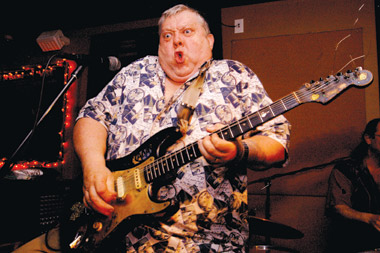
As a Southerner who's lived in Texas, Louisiana and the Mississippi Delta, I am guilty of blues snobbery. The Valley is not a hotbed of blistering blues. It's a wonderful place, but the blues does not often flourish in the shadow of yoga studios.
My first years here, I saw bands who called their music blues. I was disheartened at the lack of a certain indescribable feel that's present in even most middling Southern music, and too often lacking in Northern imitations of Southern music.
When I first heard Ed Vadas, I wasn't, I think, really listening. Maybe my ears are better now. Or I assumed a white guy born in Worcester couldn't possibly get the blues. But it only takes a few minutes of talking or playing music with Vadas to realize that his mix of studied and unstudied, of dead-on planning and seat-of-the-pants sloppiness goes a long way toward capturing that ineffable quality of proper blues. It's not the kind of thing you can fake without sounding like a wanker.
Play with him (and lots of people do sit in for a song now and then, Wednesdays at Bishop's Lounge in Northampton, including me), and you might receive any number of things from Ed: anger, disgust, a smile, an insult, an on-the-fly lesson, maybe even approval. Ed gets the music, in the way of someone who's accidentally leaking it, not hunting it with deadly precision.
He is a teacher, too, though what he teaches is more along the lines of applied philosophy than how to finger the chords to "Mustang Sally." You might not think of Wittgenstein if you've witnessed any of Ed's famously off-color jokes. So imagine a philosophical jester with a muddy voice and a sloppily dead-on guitar hand, a lewder Voltaire with the complete Chess Records catalogue in his subconcious. Just keep in mind he's famous for pissing off drummers.
Vadas, in a recent wide-ranging interview, latched quickly onto the notion of philosophy: "That's the problem. Most musicians don't even have a philosophy, " he says. "You develop a philosophy and you play that philosophy."
That's why, Vadas says, he's a teacher when he leads a band, why he arranges songs around ideas that make the most of a band. He expresses his ideas with a mix of music theory and general notions, like, for instance, everyone playing different patterns, then the same thing on just one measure in a 12-bar blues form.
Vadas also has strong beliefs about why that hard-to-pin-down blues feel is ever harder to find: "I believe in the 1980s, popular music, disco and whatever—they started using a drum machine. It would play on the beat. I mean, right on the middle of the beat. But blues and a lot of other musics sat behind the beat or in front of it on certain songs, but they very seldom played right smack dab on the middle of the beat. I've had drummers tell me there's no such thing. But some drummers understand this, and great drummers can do it."
Though Vadas respects some technically gifted players, he sees technical dazzle as only a small part of musicianship. "That's what I call 'white ethic.' Fast and clean. That's the way they make love, the way they eat food, that's the way they play music."
Expression seems central to his approach. "I can buy a roadmap from here to Northampton, but the road is 60 feet wide. So I can stay on that road, but Christ, I could go all the way over there to the other side of the lane, or cut over when there's no traffic and come back, or I could stay right in my lane. I could run a couple of lights. I could go 90 over the bridge. I could do all those things and still stay on the road. When you see the printed page, it's a roadmap, but there are lots of things that personalize it. Every day I blow away somebody who can do things on the instrument that I can just dream I could. My favorite line is, 'Boy, if I could play like him, I wouldn't.'"
You can see Ed Vadas on Wednesdays at 8 p.m. at Bishop's Lounge in Northampton with a first set with Sue Burkhardt in a duo project dubbed Ameri-MF-cana, and the rest with The Fabulous Heavyweights.