Although the Hampshire Choral Society is busy rehearsing and a symphony has been hired and sent parts to practice, a week before the Society’s upcoming performance at Smith’s John M. Greene Hall, none of the performers has yet heard the score.
Ralph Vaughan Williams is one of the most influential and beloved classical composers and conductors of the last century. Though he died in 1958 and is buried in Westminster Abbey, his catalogue of symphonies, hymns and other classical pieces is still performed, recorded, studied and enjoyed.
British composers from later in the century—such distinguished names such as Jagger, Richards, Lennon and McCartney—clearly followed closely in his footsteps, adopting much of his approach in writing music and in living their lives.
Until recently, though, one major symphonic work by Williams had gone missing. Though the work was pivotal to his career, it had only ever been seen by a handful of people, experts had never heard of it, and, since it was never performed, no one—including the composer—had ever heard it played.
The piece is about 40 minutes long and requires four soloists, an eight-part chorus of 150 voices and a full orchestra. It’s not the kind of thing that can be mounted on a whim. Unlike a long-lost track that got dropped from an album or was only recorded as a demo, this music has only ever been an idea, and for over a hundred years, no one had bothered to consider it.
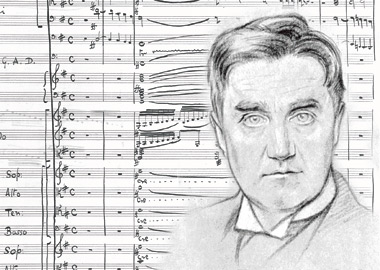
In 2007, conductor and musicologist Alan Tongue saw a page of the original manuscript on display in the Cambridge University Library. Williams had submitted the manuscript as his doctoral dissertation in 1899; after he graduated, it was filed away and forgotten by all but the librarians. Tongue got excited. He asked to see the rest and requested permission to prepare it for performance. After correcting minor errors, transcribing the handwritten document and preparing the many parts, Maestro Tongue performed Vaughan Williams’ A Cambridge Mass for the first time last year in England.
Tongue will be on hand to conduct the Northampton-based choir and a symphony made up of regional players in the piece’s foreign premiere, but only he will have a firm notion of what the final version might sound like.
As they rehearse for the Sunday, January 22 performance, the singers and instrumentalists must rely on their imaginations for the full effect.
“I haven’t even heard the whole thing,” Allan Taylor, the choir’s director, said in an interview with the Advocate last week. An accomplished musician in his own right, he is also an assistant professor of music at Westfield State University.
He has been rehearsing the choir, accompanying on piano with a simplified score. As guest conductor, Tongue will have a week to work with the hundreds of performers to dial in the sound he’s looking for, but in the meantime Taylor finds himself in the odd position of freshly interpreting a century-old work by one of the last century’s most influential and admired classical composers.
“I heard a small part from the first concert,” Taylor said. “Alan Tongue sent me a clip in an email, with a note pointing out this was the first time anyone in America had heard even that much.”
And even in the few minutes he heard, Taylor spotted places where Tongue had made choices different than his.
“At one point, the choir sings a series of Amens,” Taylor explained. “I had them doing it very clipped and pronounced. He had them blend more into one another.”
To open the performance, Taylor will conduct music for strings by composers Elgar, Britten and Holst, but he will then hand over the baton to Tongue and perform in the Mass as the organist.
“I’m very content to step aside and let Tongue take over,” Taylor said. “I’m excited to hear the work as he’s performed it.”
Though it was Williams’ first work, it’s considered one of his most ambitious. He wrote it to specific instructions that were meant to push students to their limit. Williams pushed far beyond expectations. He strutted his stuff for his professors, but more than simply showing off technical finesse, Tongue writes, his work achieved “genuine creative expression.”
*
By all accounts, British composer Vaughan Williams wasn’t much of a student.
He entered Cambridge University in 1892 and spent nine years there in pursuit of a doctorate in music. While his undergraduate professor admired Williams’ personality, he saw no future for his student as a composer. Williams himself admitted that he might well have been “unteachable.”
For many such uninspired, full-time, long-term students, the dissertation can be the rock that their dreams founder upon. For Williams, though, the act of writing his first major composition put the wind in his sails. He found his Cambridge professors deeply wise and knowledgeable but uninspiring. It wasn’t until he spent time studying abroad that he found any encouragement.
“When I came back to London, I settled down to try and learn how to compose, not by studying but by doing,” Williams wrote in a memoir many years later. Meeting the challenge of his dissertation helped him find his voice as an author.
A defining moment for the young musician, Tongue writes in a preface to the upcoming performance’s program for the Cambridge Mass, was when he heard Verdi’s Requiem.
“[E]xpecting a cheap experience from its ‘frank sentimentalism’, he instead was possessed by its power,” Tongue writes. He quotes Williams: “‘I realized that here was a composer who could do all the things which I with my youthful pedantry thought wrong, indeed, would be unbearable in a lesser man; music which was sentimental, theatrical, occasionally even cheap, and yet was an overpowering masterpiece. That day I learnt… that there are no canons of art except that contained in the well-known tag, “To thine own self be true.'”
This same passion, Tongue promises, is in the Mass.
*
Though New York or Boston might seem a more likely venue for the premiere of such an important work, the Pioneer Valley’s dedication to cultivating its own homegrown, alternative identity would likely have appealed to Williams. In both his music and his life, he made a habit of defying expectations.
Even though he had the means to pursue an education—one his professors thought useless outside academia—at Cambridge for a decade, and he adopted an art form generally enjoyed by an elite, Williams devoted much of his life to his passion for collecting traditional English songs.
Much like the Brothers Grimm (who collected German folk songs 50 years earlier), Williams feared that British folk songs—the ones he heard at pubs, over a pint, as opposed to the stuff of concerts and cathedrals—were in danger of extinction.
As sheet music, radio and records became the way songs were being shared, musicians across the country were learning from a single source, rather than from the way their parents sang something. The idea that there was a “right way” to perform a song was beginning to turn music into something people enjoyed passively, for fear of doing it wrong.
In addition to collecting songs himself and transcribing the many variations he found as a scholar, Williams wove these folk melodies into his own symphonic works. It wasn’t enough to archive these melodies that he cherished so deeply; he saw it as his job to keep them alive by reuse and invention.
Every time Sir Mick Jagger writes a country song that demands it be sung with a Southern twang or Sir Paul McCartney adds strings to a fluffy pop song, it’s evidence that Vaughan Williams is, in part, responsible for helping to nurture a nation of music lovers aware of traditions with which they work and not afraid to adopt them as their own.
His devotion to his country’s arts and traditions was evident beyond his music, though. He grew up with great privilege on a sizeable estate (one that his great-uncle, Charles Darwin, visited regularly in Williams’ youth), but when he inherited it, he donated it to the public trust.
When the First World War broke out, he was 42. He was old enough to avoid enlistment and well bred enough to have joined as an officer, working far from enemy lines. Instead, he volunteered as an ambulance driver, witnessed the death of many of his friends, and suffered acute hearing loss from heavy combat.
Though he wrote hymns and masses all his life, for much of his adulthood he was an atheist. Still, his works—especially those from after the war—convey a deep spirituality.
Unlike Jagger and McCartney, though, when Vaughan Williams was offered a knighthood, he rejected the title as a statement against the wars his country’s leaders forced the common people to die in.
*
“I wish I could tell you our choir was chosen to premiere the piece in America because we are the best voices for the job,” Taylor told the Advocate, “but in point of fact, it’s more a matter of luck and coincidence. The first choice for the job—a choir and symphony out West—had to drop out, and Tongue was friends with people in the choir. We saw an opportunity and jumped for it.”
The Hampshire Choral Society has been around for over 60 years. Based in Northampton, it’s the largest amateur choir in New England, welcoming singers of all abilities from all around the region, from age 18 to much, much older. While the Mass won’t be the most challenging work the group has attempted, it’s close.
“Because it’s sung in eight parts, we need to divide singers into smaller groups than they’re used to,” Taylor said. “They like to lean on one another a bit, so having to be more independent, even some of the stronger members are feeling the starch knocked out of them a bit.”
Beyond the technical challenges of singing an ambitious masterwork, the volunteer choir has also had to take on the business challenges of launching the complex production. Chief among those challenges was that Taylor needed to hire a professional symphony and soloists to accompany them.
“Just about everyone performing with us is from the area, some from northern Connecticut and a few from the Boston area,” he said, “but I really made my goal to keep things as local as possible. When people heard about the project, I got a lot of calls from people just begging for a chance to perform. Offering that chance has always been what the choir has been about.
“This is something that no one in the choir could ever dream of attempting alone,” Taylor continued, “but as a group, they have more than they need to take it on.”
Asked if he was nervous about the performance, he laughed and pulled out the score. Flipping through to somewhere in the middle, he pointed to a place that had him worried. For half a page, there was a long silence.
“I have to silently count out all these measures, and then, bam! Here I have to come down with this booming chord on the organ. If I get it wrong, there will be nowhere to hide,” he said. “Everyone’s going to hear what I’ve done. It’ll be shaking the building to its core.”
Jan. 22 (snow date Jan. 29), 3 p.m., $15/students and seniors, $20/general, John M. Greene Hall, Smith College, Northampton, www.hampshirechoral.org.