Last year, there were 12,233 foreclosures in Massachusetts, a 32 percent climb from the previous year but not quite as many as in 2008, when a record 12,430 owners lost their properties.
So far this year, there have been 10,610 foreclosure petitions filed in the commonwealth, according to figures from the real estate publication Banker and Tradesman, which reports that the pace of foreclosures has picked up in recent months.
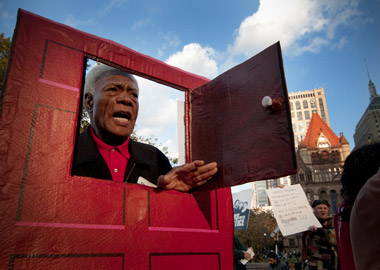
For the past three years, Boston-based photographer Kelly Creedon has been documenting some of the individual stories behind those numbers. The resulting project, “We Shall Not Be Moved,” funded by a grant from Mass Humanities and the Puffin Foundation, features families who have lost their homes to foreclosure, as well as community organizing efforts to help individuals and neighborhoods hurt by the foreclosure crisis.
Now the traveling exhibit is coming to Springfield, a city only too familiar with that crisis. Last year, there were 595 foreclosures in the “City of Homes”—more than in any other community in Massachusetts.
*
Creedon came to documentary photography from a journalism background, which led to an interest in community-based media, she said. Her documentary work includes portraits of Latin American immigrants who work as cleaners in Boston; a profile of a 23-year-old pregnant homeless woman trying to keep her baby from ending up in state custody; and a series on the Evangelical movement in El Salvador.
“We Shall Not Be Moved” began with Creedon’s coverage of City Life/Vida Urbana, a community organization in Jamaica Plain that brings together people who have been foreclosed on to advocate for themselves and each other. For the past few years, she’s photographed members of the group as they’ve rallied outside banks and protested at foreclosure auctions.
More recently, Creedon also began working with Springfield’s No Ones Leaves/ ?Nadie Se Mude!, which does similar work here. Next, she said, she will begin covering the anti-foreclosure movement in Worcester, Lynn and Lawrence.
Creedon was drawn to the foreclosure project, she said, “because I’m interested in talking about social issues, but I’m also interested in what gives people hope.” The anti-foreclosure groups, she said, are a moving example of how community-based power and resources can be used to make real changes. “That was what was really exciting to me about this movement in Springfield and Boston,” she said. “When you look at No One Leaves, and what they’ve been able to accomplish in about a year, it’s really exciting.”
Founded in the fall of 2010, the local group—an alliance of community organizations and, most important, people facing foreclosure themselves—calls on lenders to negotiate new loans with struggling homeowners rather than force them from their houses, and advises people facing foreclosure or eviction on their legal rights. No Ones Leaves/Nadie Se Mude also organizes protests outside foreclosure auctions and rallies at banks; last week, the group and allies from other cities in the region marched from the South End to the Bank of America in downtown Springfield, where they staged a sit-in. Fifteen people were arrested on trespassing charges.
No Ones Leaves/Nadie Se Mude also successfully lobbied the Springfield City Council to pass two new ordinances addressing foreclosure issues this summer. One requires lenders to participate in a mediation process with borrowers before they can file for foreclosure; the other requires banks to put up refundable bonds on foreclosed properties they own in the city to ensure that they don’t let the vacant buildings fall into disrepair. The Mass. Bankers Association has protested those ordinances and indicated that it might pursue legal action against the city.
*
“We Shall Not Be Moved” is a multi-media exhibit featuring still photographs and audio of Creedon’s interviews with her subjects. In addition to her Boston-based work, Creedon has included images from the Springfield movement, much of it focusing on the Dunwell family, who’ve been fighting to keep their home in Forest Park. The family fell behind on their mortgage payments after the father, David Dunwell, lost his long-time job with a social service agency. He’s now employed again, as is his wife, Yanick, and the couple, who have three young daughters, have been trying unsuccessfully to work out a deal to buy back their house or rent it at market rate.
Alongside Creedon’s exhibit will be a local component with work by members and supporters of No Ones Leaves/Nadie Se Mude, including video by Joe Oliverio and Robbie Leppzer and photographs by Oliverio, Ruben Santiago, Barry Scott, Lauren Marcous, Leo Maley, Sue Gamelli, Ashley Tolbert and Anne Yukie-Watanabe.
“We’re really trying to create a collaborative event,” said Creedon, who met with No Ones Leaves/Nadie Se Mude members to talk about how they’d like to see their story told—”what things did they think would help the community understand who they are and what they’re fighting for,” she explained.
The exhibit will be held at 176 Worthington Street, in a vacant storefront managed by NAI Plotkin, a Springfield commercial real estate firm. The company is letting organizers use the space free of charge, something it’s done for a number of art exhibits at its vacant properties in recent years, in the belief that a burgeoning arts community will help revive the city’s downtown.
“I’m trying to roll out the red carpet to artists of all different persuasions, whether the visual arts or other types of arts, too, so we can become more of a cultural destination than we have been in the past,” Evan Plotkin, president of NAI Plotkin, told the Advocate.
Plotkin stopped short of endorsing the anti-foreclosure campaign—”It’s definitely not a political statement on my part,” he said of his decision to lend the space to No Ones Leaves/Nadie Se Mude. But, he added, “I think that the folks that are being evicted and so forth deserve a voice. And I think when you can create voice through art, that’s one of the great things art can do. It’s powerful stuff.”
Powerful enough, Creedon hopes, to inspire viewers to begin thinking differently about the issue. “One of the things that I find challenging about the foreclosure crisis is the ways it’s covered in the media,” she said. Much of that coverage focuses on empty homes and the resultant problems for their neighborhoods, like increased crime and falling property values. But that’s not the entire story, Creedon said.
“There’s this flip side of the coin: people who are not walking away, not giving up, but are really fighting [and] creating a movement to push back. I think it’s really inspiring, really hopeful,” she said.
“These houses didn’t belong to investors who overreached and walked away. These are peoples’ homes, these are families, people who really care about their homes and are willing to make some really difficult choices to stay, making their case public. That’s really hard.”