
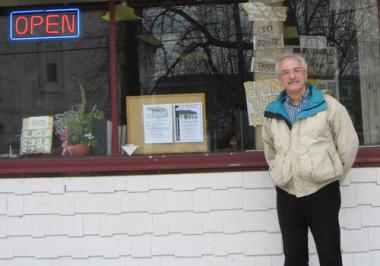
It’s a few days before Christmas and I’m avoiding the elements and the holiday crush by hiding out in one of my favorite refuges, Easthampton’s Cherry Picked Books.
“Is this one for you?” asks Michael Engel, the shop’s mild-mannered proprietor, as he picks up Tim O’Brien’s Going After Cacciato from the top of my culled stack and thoughtfully turns it over while ringing it up.
“Yes,” I reply. “I’ve only read The Things They Carried, but I loved it.”
“Well, this one definitely takes things in a different direction. It’s very surreal. I think that the absurd elements put a lot of folks off, but you’ll get it—I think you’ll enjoy it.”
Engel, an emeritus professor of political science at Westfield State College, knows his books—and his customers. And now this small business owner, veteran and former educator and Easthampton selectman and school committee member would like to add something else to his resume: United States Congressman.
Running as an Independent, he’s looking to unseat longtime Democratic Congressman John Olver in Massachusetts’ First District. Like many Americans on both the left and right, he’s fed up with Washington.
*
“The idea came to me just like that,” Engel says, snapping his fingers, as we sit in his quiet Main Street shop on a Sunday morning. “It was sometime in August, and I was thinking about the state of the country—it had been in the back of my mind for a while, but I was driving a car, and I thought, ‘Maybe I should run for Congress.’ There’s so much negativity around and I kept thinking, ‘Something’s got to turn this around. Let me do it.’ I remember going home and telling my wife and my daughter and they said, ‘Great idea, great idea!'”
I ask Engel what makes him a good candidate and he quickly ticks off his accomplishments: “I was professor emeritus of political science, taught American politics for over 30 years; served two years in the Army; [was an] elected official in Easthampton, beat Democrats twice as an Independent. And running a business, which has a lot of legitimacy from people—I’ve learned a lot from being a small business person, so I think I have a lot of background, a lot of qualifications. I think my 30 years of teaching political science—some political scientists are so abstract, are so computer-oriented, so theoretically oriented, that they really don’t know what’s going on—I think I’ve learned something in my 30 years. That’s why I don’t feel the need to hire any consultants or anything.”
Engel, who now resides in Southampton, is certainly not afraid to speak his mind on the issues, unlike certain Washington regulars. “Take Afghanistan,” he says. “Olver has no position on the war in Afghanistan. None. How is that? There’s something going on there. I’m not sure why reporters haven’t investigated this further. Of course I support an immediate withdrawal.”
I ask him for his take on the health care imbroglio.
“I would have voted against that bill,” Engel says, without hesitation. “It empowers the insurance companies. The Republicans are right: the finances are fraudulent. I’m on Medicaid, and [Obama] says he’s going to take $500 billion out of it in waste and fraud? Is he out of his mind? That’s going to affect me. So it’s fraudulent financially. It’s not the right approach.”
His frustration with Washington machinations—and, indeed, Obama himself—surfaces again when we discuss the bailouts.
“Obama had the chance to change the system,” he says. “Instead he rebuilt the whole financial structure, which is going to fail again. Instead of replacing it, instead of using his mandate for something, he decided to throw trillions of dollars at something designed to rebuild the same old system that failed us in the first place. That’s a bankrupt strategy, and I think most Americans realize it.
“His money came from Wall Street. I was never an Obama worshipper—I voted for him, but I am astonished at his political ineptitude. I am just astonished at what he’s doing, and it’s sort of sad, too. Some people are just angry, and call him names, and paint Hitler moustaches on him, but I just think it’s unfortunate—I was thinking that an African-American from a multicultural background had a chance to really be something special.”
Engel is also a self-proclaimed democratic socialist on economic issues. I ask him if he’s intentionally trying to prod the right, knowing full well that the term is being used in attempts to raise funds for conservative candidates and scare the bejeezus out of the general public.
“For a hundred years it’s been used as a four-letter word, and I put it on my website because I’ve been on the record as such. What I hope to be able to do is explain to people what I mean by that, and it’s not at all what people think it is. Obama’s no socialist. Democratic socialist means that we as people need to control the economy. Does that mean that we should own it, that the government should own it? No, we have to control it—the free market doesn’t do it. That’s democratic socialism. Bernie Sanders is the best example I can do, and most of the way Bernie Sanders feels is the way I feel, and I haven’t heard anybody react directly to it yet. I’m not making it the centerpiece of my campaign, and it only really refers to my ideas about the economy, but it’s there.”
The themes of personal accountability and citizen involvement are ones Engel continually returns to as we discuss his philosophies.
“I’m not running because I have a specific disagreement or issue with John Olver,” he says. “It is really the thought that something’s got to be done, and one of the things I’m saying is that we’ve got to stop looking at Washington to change things for us—that is, electing a leader that can change things for us. My main message is, we’ve got to do it, and if elected I can help you do it, which is a whole different approach from the normal Congressional representative.”
*
I ask Engel about running as an Independent, thereby putting himself at a distinct disadvantage in terms of support structure and funds. He seems undeterred, even elated, by the prospects of taking on the two entrenched parties.
“We have a great grassroots support group, lots of great volunteers,” he says. “And this year the word ‘Independent’ is an advantage. We’ve been going out and collecting the 2,000 signatures [needed to get on the ballot]. We’ve got over a hundred in the last few days, with over 20 volunteers out there, and when I say Independent, people start signing. And it might also be an advantage with [state treasurer Tim Cahill, now a candidate for governor] running as an Independent. He’s a conservative, but an Independent. I’m making sure I get on the ballot as Independent, not ‘Unenrolled.’ So people might see that and say, Oh, here’s one Independent, and here’s another Independent! A coattail effect. So Independent works.
“I’m not beholden to anybody—no party, no special interest groups—and maybe I shouldn’t quite put it this way, but I don’t care about reelection. I just want to do this for two years; I’m not building a career. I don’t want to be Robert Byrd, being wheeled in to a vote—I don’t want this. I’m going to be 66 in April, so I want to serve two years. I’m not even thinking about what I want to do in two years, so I don’t care about the interest groups, I don’t care about the lobbyists. I care about staying in my district as much as possible and working with community groups. I want to do a job.”
To counteract his inability to purchase TV and radio ads, Engel tells me he will be traveling throughout the district, attending as many town meetings as humanly possible. “It’s going to be personal effort, volunteers, getting out there,” he says. “The main strategy I have is the town meetings, 90 of them in this district. I don’t think I can go to all of them, but I’m going to go to as many as I can.”
Engel is relying heavily on his family for the campaign. His daughter Emily, who also fills in for him at the shop, created his website and handles all social media operations; daughter Sara is a graphic designer responsible for posters and visuals; and he says his wife Jackie “is right out there with me, giving me valuable advice every step.”
“It’s a family project,” he says. “It wouldn’t work if it weren’t for that.”
Finally, as the bell over the shop’s front door rings to announce the arrival of the day’s first customer, I ask Engel how effective he thinks he can be if he’s sent to Washington.
“I mean, a freshman Congressman is not going to go into the Capitol and introduce laws. I would add one thing, though: people might say, how could an Independent have any clout? Well, I’ve thought about this. A quick political science-y example: Olver’s subcommittee, Transportation, Housing and Urban Development, has 12 members: eight Democrats, four Republicans. What if the Democrats lose seats? Well, the balance changes; it could be seven Democrats and five Republicans, or six Democrats and five Republicans and one Independent—the Independent holds clout. I hate to use [Connecticut Sen. Joseph] Lieberman as an example, but an Independent in a closely divided Congress could cut some deals, and I don’t mind using that expression, even without seniority. And I don’t have to follow the orders of Nancy Pelosi. I think there’d be something of an advantage in this.”
For more information, visit www.engelforcongress.org.