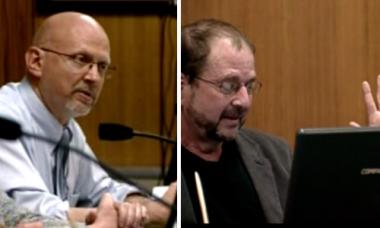
Two hours into the May 7 Northampton city council meeting—a meeting at which the council voted to put a $2 million Proposition 2 1/2 tax override on the ballot this June—Councilor At-Large Michael Bardlsey took the floor to voice his disagreement with the way in which Mayor Clare Higgins' and other tax override supporters have framed the issue for the public.
Bardsley, who is challenging Higgins for mayor in the November election, made four points at the council meeting. First, he reminded the council that the financial crisis that the city is facing was a growing problem long before the collapse of several Wall Street banks last fall; the likely need for an override, he said, surfaced well over a year ago. He then said he disagreed with how the city's employee unions have been treated by the mayor, who said she wouldn't seek an override until the unions accepted pay freezes—a plan she ultimately failed to live by. Bardsley also asked for a line-item budget, rather than the summary of the budget Higgins and her staff have so far provided. Lastly, he said that, in these "extraordinary times," the city could not afford to be dismissive of people who offer alternative means of raising revenue, such as a group that volunteered to put its professional fundraising skills to work on behalf of the Northampton schools.
While Bardsley supported the proposed override, he said there was an important piece missing from the debate: a plan for what happens next.
City Councilor Paul Spector, who rocked in his chair with his arms crossed during Bardsley's comments, raised his hand the moment his fellow councilor had finished. He eagerly announced that he wanted to respond to what Bardsley had said.
Spector said the city should, indeed, be dismissive of private fundraising efforts. "I thought in the last election faith-based government was voted out of office with President Bush," he said, obliquely. "Because we can't base this on what we hope will happen, whether it's stimulus money or contributions." Over the next five minutes, he reiterated this point without specifically relating it to what Bardsley had said.
The next morning Spector appeared on WHMP's Bill Dwight radio show. Bill Dwight, a former councilor and friend of the mayor, said Spector had been invited to discuss the override and the council's decision to put it on the ballot. Instead, during the half-hour interview, Spector continued riffing on how off-base he thought Bardsley had been, rehashing much of the material he'd used the night before and grossly misrepresenting what Bardsley had, in fact, said. At one point, for example, he falsely claimed that Bardsley had recommended holding bake sales to raise money for the city.
Spector told Dwight that he understood some people were suffering in this economy and others were scared of suffering, but he thought Bardsley disrespected voters. "It's our job as city councilors… to be leaders in the sense that, making sure the facts are on the table. And then it's still a hard conversation. Unfortunately, last night what I thought happened was close to demagoguery on this issue."
Dwight apparently failed to see the irony in what Spector was trying to do.
*
One of Paul Spector's favorite talking points in recent years has been what he views as the uncivil, overly personal nature of the criticism often leveled at public officials in Northampton. He's repeatedly asked for people to engage in civil debate and urged voters to get informed. Spector, however, is often the first councilor to engage in emotional, personal and hyperbolic attacks that steer far clear of the issues at hand.
I spoke to Spector a few weeks ago, when I called him looking for his reaction to a remark Bardsley had made about Spector not having much faith in those he served. Understandably, Spector was angry, but before he made the comment I ended up using (and before he told me he thought the Valley Advocate was the liberal equivalent of Fox News) he asked me if he could go off the record. I declined the opportunity to learn what he thought was too hot for his constituents to hear. On the record, he told me Bardsley only thought of his own political future and would say anything to get elected.
When Bardsley addressed the council on May 7, he chose his words carefully, and he spoke a bit nervously, as if anticipating a reaction like Spector's. Bardsley was the council president for many years, during which he had mainly good relations with the other council members. When, however, he criticized the mayor and the council three years ago—at issue was the controversial Smith College overlay district—the reaction was swift and unforgiving. After the next election, the city council voted to end Bardsley's tenure as council president, replacing him with Jim Dostal, a Higgins supporter.
*
Last week, I interviewed Bardsley about his May 7 remarks to the council. First, I asked him whether he would vote for the override.
"If the schools weren't so vulnerable, I'd consider voting against the override, but they've been operating on insufficient funds for a long time. If it doesn't pass, the cuts will be devastating."
While he said he would vote for the override, he felt voters needed to understand Northampton's finances weren't going to be fixed by this one vote. "There may have been things we could have done five years ago to avoid this, and it may take many more to get the city on solid footing again. All that's being discussed on the council right now, though, is getting the override passed, not how we're going to avoid asking for the same thing next year."
Elaborating on why he felt Higgins' approach to negotiating with the city's unions was unfair, he pointed to the April 29 edition of the Daily Hampshire Gazette, which published a column by Higgins stating that she would not ask for an override unless the city's unions agreed to a pay freeze first. She argued that it would be "unconscionable" to ask property owners for more money if the police, fire department and other city unions didn't agree to similar sacrifices.
She asked for the unions' responses by May 1, but by the May 7 meeting, not all unions had responded; by the mayor's own reckoning, therefore, what the council was deliberating, what it ultimately voted for, was unconscionable.
Bardsley, a member of a union himself, told me he'd been hearing from city employees who felt they'd been set up to be Higgins' scapegoats: if the override failed, she would blame the unions.
Her strategy of pushing the unions for concessions before holding the override vote seemed to defy logic, Bardsley said. If he were a union leader, he said, he'd want to see whether the override passed before making concessions. Otherwise, it might just be the unions who were making sacrifices.
Bardsley also defended his request for a line-item budget. While Higgins and her staff have prepared PowerPoint presentations and supplied handouts with easy-to-read, digested versions of the budget, only she and her staff, including city finance director Christopher Pile, have been taking their knives to it, Bardsley said. The city council gets to nibble on what's put before them, but they haven't been allowed into the kitchen or near the raw numbers. Bardsley said he felt it was the duty of the city council to be involved in the budget preparation, not just spectators to the process. Even if, after seeing all the numbers, the council came to the same conclusions as the mayor and her staff, a better understanding of where the money was going would help them prepare next year's budget.
"The council has the power to make cuts, and I think we need to be able to say we've scrutinized the budget and made all cuts possible," he told the council on May 7, relating how at a recent override meeting, a member of the school committee had said that her committee had gone through the budget and made it as lean as possible without drastically affecting services. "I, in all good conscience, can't say the same," Bardsley said, "because we as a council haven't seen the budget, and we haven't gone through it line item by line item."
At the May 7 council meeting, Bardsley told the council that, since efforts have failed to get other revenue-raising methods, such as a meals tax, passed it might be time to explore alternate private funding options. "I know that about a year ago there were a number of folks connected with one of the elementary schools who had a proposal to do a private fundraising effort," he told the council. "I don't think we can be dismissive of those kinds of efforts any more. These are extraordinary times, and when the support from the federal government and the state is decreasing, we can't constantly go back to our taxpayers and our employees. This is a long-term effort. It wouldn't help us out necessarily this time, but I think what's lacking is an overall long-term plan."
In our interview, Bardsley amplified his earlier comments about fundraising—comments that inspired Spector to scoff and accuse Bardsley of wanting to hold bake sales. Bardsley said the people who'd made the proposal were professional fundraisers for out-of-state private schools and their offer to help, he said, was rebuffed by Higgins.
*
In addition to being dismissive of private fundraising efforts, Spector sneered at the request for a line-item budget during his radio chat with Bill Dwight. "[Bardsley] implies you can go through this budget and go through this massive amount we're spending and find all these line items…."
When Dwight interrupted and asked him, "Well, as a councilor, shouldn't you be going through budgets line by line?" Spector changed direction on a dime.
"You know, you should," said Spector. And then he began to talk about some of the budgets he'd seen, how few departments there were, and how easy it would have been to get this information, though he hadn't done so himself.
Thus far, Higgins has not provided Bardsley with the line-item budget he requested.