
It’s easy to think of December’s in-between season, when the leaves are gone, the grass is dead, and cold winds scour the Valley, as a drab time that proves it’s darkest before it’s even darker.
As I write this, I look out at a sky whose blue has gone pale around the edges, as if its color can’t be fully sustained in the frigid air. The brilliant orange and red of New England autumn is gone. Now we wait through long nights in the salmon glow of the neighbors’ lawn reindeer for the holidays to erupt. Then it’s a joyous time of over-promising in the flurry of a new year’s optimism, followed by packing away the garlands and candlesticks for the long season of snow shovelling.
This year seems different. Yes, the wind threatens the nethers and the nights grow fat. But along that same edge of sky that’s gone pale outside my window, a stand of trees trumpets limbs upward in the manner of ecstatic worshippers. Most years, I wouldn’t pay them any mind—the Valley is full of the deciduous things, and they are, after all, just trees naked of their leaves. This time around, though, those trees echo with odd coincidence.
Not long ago, I reviewed in this column a book called Portraits of the Mind. It’s a collection of images of the brain, including everything from Renaissance-era drawings to contemporary MRI and electron microscope images. In many of those images, new and old alike, neurons look startlingly like plants, particularly like the leafless trees and hedges of early winter. Nature seems to have found its story worth sticking to. In some of the book’s pages, it’s easy to let go the idea that you’re looking at a neuron—let the image blur a bit and you might as well be looking at ghostly trees lining a shore, or an aerial photo of leafless branches poking up from a flood. After flipping through Portraits of the Mind, all these winter-bare trees seem like spillage, as if the internal landscape of the brain has taken to the exterior.
One such coinciding of imagery is mildly interesting, the kind of curiosity that makes for a nice metaphor. But last week’s column brought to light a third point of branchy convergence.
In writing about speculative fiction author China Mieville’s unusual version of blogging, I looked into Georg Christoph Lichtenberg, an 18th-century German whose posthumously released notebooks (or “waste books,” as he termed them) gained him a measure of literary fame. Mieville prominently features a Lichtenberg quotation, and seems to have been inspired by those notebooks.
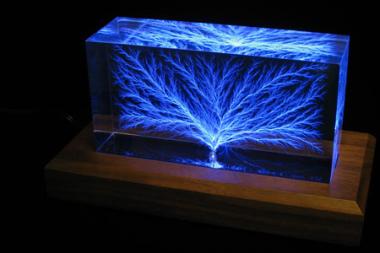
Lichtenberg is perhaps most famous, however, for his discovery of “Lichtenberg figures,” which are the images sometimes left by an electrical discharge on or in an insulating material. They look, of course, startlingly like trees, and are fractals—no matter how magnified the image, you can see the same patterns repeating.
Lichtenberg figures bring the circle of coincidence right back to the internal. Researchers are looking into a remarkable use for such figures, created by releasing an electrical discharge into an acrylic block: they believe the branching pattern may be the perfect form in which to channel artificially grown blood vessels for artificial organs. The Lichtenberg figures create a pattern that works very well as a vascular system, down to the level of capillaries. (It’s worth noting that biologically produced vascular systems seem to at least resemble fractal systems, though that’s a matter of ongoing study.)
I don’t know quite what this kind of connection reveals, whether it’s the kind of illumination of universal nuts and bolts that gives theologists comfort, or merely proof that nature is efficient in its complexities. I know this much: as I look at that line of trees fracturing into the sky, I think about lines by William Carlos Williams, what the poem records as the last words of his grandmother: “What are all those/ fuzzy-looking things out there?/ Trees? Well, I’m tired/ of them.”
And I’m pretty sure that, despite the cold wind and the lack of their autumn finery, I’m not tired of them at all.