The last time a meeting of the Citizens Advisory Committee (CAC) adjourned, back in June, there was still a glimmer of hope that the development on Northampton's Hospital Hill would contain some element that might serve the public.
The CAC has been overseeing the development on Northampton's Hospital Hill for over a decade, and this spring they voted unanimously to allow local military contractor Kollmorgen Electro-Optical to relocate its manufacturing plant to the southern campus of the former state hospital. While no dissenting votes were cast, there seemed to be general agreement that the large industrial plant and parking lot fell far short of the planned mixed-use village that might attract new businesses and industries.
During the June meeting, after touring the housing development now being constructed on part of the northern campus, the chair of the committee, Northampton Mayor Clare Higgins, suggested fellow members consider the wide-open meadow and forests remaining on the hill. There, she suggested, was an opportunity to do something to balance the Kollmorgen plant. Several members pointed to the need to add more commercial locations to the mix, some wanted a community center, others playgrounds, and it was reported that the memorial subcommittee wanted a restored fountain placed near its original location.
As the meeting closed, the mayor assured them the undeveloped portions of the site were a blank canvas. This meeting, she said, was to review where things were currently, answer questions, and give members a chance to consider how or if they wanted to develop it. When they all got together again, they'd have a brainstorm.
The forecast was off, though.
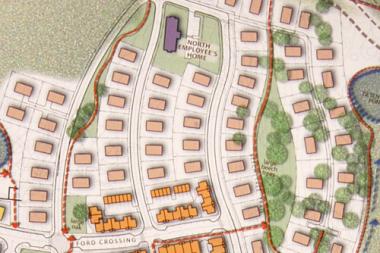
Instead of an opportunity to share their ideas, at the next meeting, on September 24, the CAC got to see what the Somerville architectural firm, Arrowstreet, had been dreaming up over the summer. It doesn't appear that they heard the CAC's concerns. Working for Mass Development, the state-based group overseeing the development, the architects didn't have many ideas about adding more commercial buildings to the mix, and they didn't offer any mixed-use solutions. They couldn't be too certain about a community center at this time; they'd have one, but how big and where were questions for a later date. They knew of one place where there could be a playground and would think more about other possible locations. They offered four alternate locations for the memorial fountain.
The one thing the architects and MassDevelopment, the site developers, were clear about, though, was that they wanted more houses: a hundred more units in addition to the nearly 200 being built or planned. They recommended developing all available flat open space for houses arranged in ice-tray regularity across fields and through woods.
A few committee members had pressing questions.Rutherford H. Platt of the National Alliance for the Mentally Ill wondered how child-friendly the design was, and cited the need to have public spaces where people could gather and recreate.
Harriet Diamond, representing the Grove Street neighborhood, seemed uneasy with the tight patchwork of houses to be built on the footprint of the former State Hospital. Currently there's a wide, flat field with sweeping views of the Valley. She said it didn't seem to her that the proposed chessboard of houses took the hill's scenic features into account. She wondered whether some of the hilltop couldn't be made public, and whether the center could be preserved as a common space with houses built around it.
Laurence S. Spang, the Arrowstreet architect presenting his rows of houses with "variation, but not too much variation," pointed out that children tend to take over any place they live, but his firm might consider finding more playground space.
Beth Murphy of Mass Development said they'd considered a plan with a park at the center, but decided it would give the people closest to the park a sense of ownership unequal to other residents, suggesting that this was somehow unfair. The architect chimed in that such configurations—houses around parks—didn't work.
He argued that people don't typically use "big lumps of open space" unless they're given design and structure, suggesting that the space would be wasted if left untouched and vacant. There would be public paths running through the site, many of the specimen trees would be preserved, and the greenery on the steep slopes at the edge of the property, which were difficult to build on, would also be preserved. This, he contended, was sufficient green space preservation.
Bruce Fogel, representing the Chamber of Commerce, declared that the proposal left him feeling "uneasy moving toward concerned." He reminded his colleagues that for over a decade the plan had been for the development to be mixed-use, and this new plan did nothing to incorporate any new commercial or business office options.
The architect, MassDevelopment and city officials said they were still looking at the Route 66 intersection as the place for commercial development, and several suggestions were made for fitting in more options.
Both Platt and Diamond returned to their concerns that the plan seemed a little too "cookie-cutter," but since another meeting was set to start in the same community room at the J.F.K. Middleschool, Mayor Higgins, the chair of the CAC, pushed to adjourn. The plan was a draft, their concerns had been noted, and they could discuss them further at the next meeting.
Several committee members thanked the architect and praised the firm for the hard work they'd done in assembling the plans. While the material had been slickly presented and clear, it was difficult to find the grounds for praise. The chief focus of the designers did not appear to be satisfying the wishes or concerns of the committee, but seeing how many extra units they could fit into the available space. After seeing the ideas Notre Dame's urban design undergraduate team generated in a week's worth of work in September, it's difficult to understand why the lackluster approaches offered to the CAC would take three months to generate and fall so far from the mark. The hundred extra units will essentially complete a project that's been ongoing for decades. While the CAC itself was formed to make certain the development proceeded with the public's interests in mind, this agenda has been abandoned in favor of protecting the interests of private developers, contractors and realtors.
Many quintessential New England towns, including those in the Pioneer Valley, feature a commons at their center, usually a "big lump of open space" with little design or structure. Commons are used for a multitude of purposes by many more people than live directly adjacent to the space. Most successful public parks feature as their centerpieces vast lawns, which attract thousands of people weekly to use the space however they see fit. Mass Development's and Arrowstreets' arguments for their development's rigid, unimaginative layout are hollow. They suggest that rather than working to find the solution that is in the interests of the site and Northampton's public, the developers are eager to wind things up as quickly as possible.
Before the mayor was able to get her motion to adjourn seconded, Charles DeRose, former Daily Hampshire Gazette publisher and representative of the Northampton Development Corporation, was the only CAC member to openly urge caution in proceeding, given the week's historic calamities on Wall Street. Whatever happened with the remaining open space on Hospital Hill, he urged that the decisions made be market-driven.
Before the meeting disbanded, Teri Anderson, Northampton's director of economic development, handed out a "best practices" survey for members to fill out so they could comment on how they felt the CAC meetings had been run. She'd already filled out much of the survey, and she gave them photocopies to sign and return to her. If they wanted, members could add something at the end.
It would appear that city officials have grown so used to assuming consensus at these meetings that they now have a systematized approach for unifying their voices. Given that the Citizens Advisory Committee's advice isn't solicited or listened to when given, it would appear these meetings have become a formality developers, the city and members all appear eager to put behind them.